
What Is Tronc Management for Hospitality Businesses?
If you run a restaurant, bar, hotel or any hospitality business where customers tip, you’ve probably heard the word “Tronc” thrown around, usually alongside “compliance,” “HMRC” and, more recently, “the Tipping Act.” Here’s what it actually means, why it exists, and what running one properly involves in 2026.
What is a Tronc?
A Tronc is simply a pooled arrangement for sharing tips, gratuities and service charges among staff. Instead of tips going straight from customer to individual server, they’re collected centrally and then divided up, usually across the whole team, not just whoever happened to serve a particular table. The term goes back further than most people expect: “Tronc des pauvres” were collection boxes used in the 1920s to gather donations for the poor, and the name stuck as the model was adapted for hospitality tipping.
The person or organisation responsible for running the scheme, deciding how the pooled tips get divided and making sure it happens fairly, is called the Troncmaster.
Why do hospitality businesses use a Tronc scheme?
Two reasons come up again and again: fairness and cost.
- Fairness – pooling and sharing tips means kitchen staff, hosts and other team members who don’t handle customer-facing tips directly still share in what customers give the team as a whole, not just whoever served a particular table.
- National Insurance savings – tips distributed through a properly constituted Tronc, with a genuinely independent Troncmaster, are exempt from employer and employee National Insurance Contributions. Run tips through payroll as a straight wage top-up instead, and both employer and employee pay NICs on it.
Since October 2024, the Employment (Allocation of Tips) Act 2023 (the “Tipping Act”) has made fair and transparent tip allocation a legal requirement, not just good practice. A properly run Tronc is the clearest way to demonstrate you’re meeting it.
How does a Tronc scheme actually work?
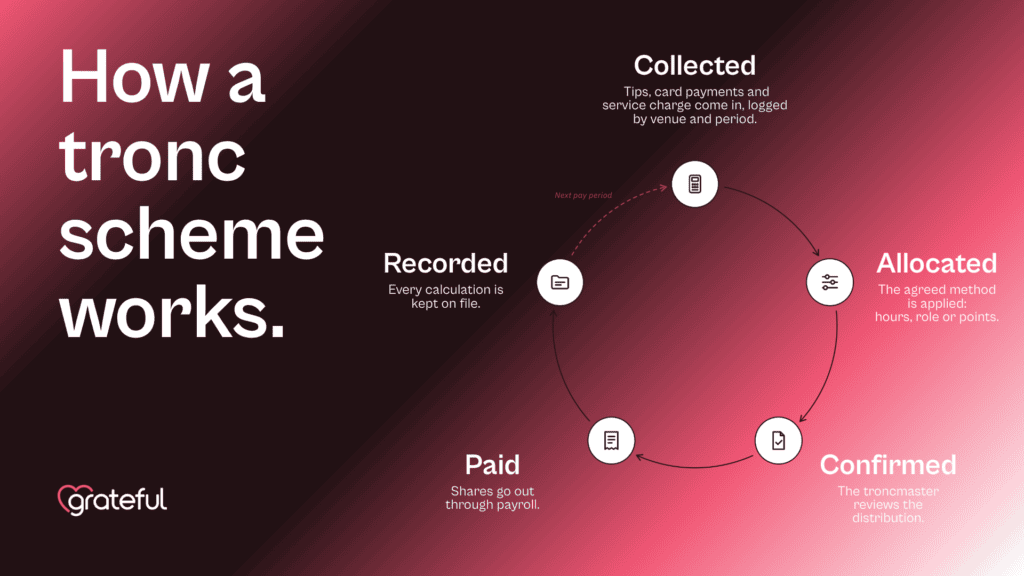
In practice, a Tronc scheme has a few moving parts:
- Tips are collected; cash, card, service charge, however they come in, and recorded against the venue and period they relate to.
- A previously agreed allocation method is applied by the Troncmaster, often based on hours worked, role, or a points system agreed with the team, to work out each person’s share.
- The Troncmaster reviews and confirms the distribution is compliant with the Tronc policy and applicable laws.
- Amounts are paid out, usually through payroll, with tax handled correctly and NIC dispensation applied where the scheme qualifies.
- Records are kept, because if HMRC or an employment tribunal ever asks how a distribution was calculated, “trust us” isn’t a good enough answer.
In-house Troncmaster or outsourced?
Both models are legitimate, and both can be compliant. Which one makes sense depends mostly on how many sites you run, and how much this needs to not be somebody’s part-time responsibility.
A team member or your accountant acting as Troncmaster can work fine for a single site with a stable team, assuming they are an individual who genuinely understands the rules and can be trusted with employees’ personal data. This option can work, but it can also be risky; it tends to strain as soon as you add a second site, higher staff turnover, or more complex allocation rules.
Outsourcing to an independent Troncmaster, like Grateful that sits outside your organisation, solves three things at once: it removes any question about whether the employer is influencing individual allocations (which is what keeps the NIC exemption safe), it takes the admin off your plate, and it gives every team member visibility into exactly how their share was calculated.
What trips businesses up
Receiving tips into a business is simple. It’s paying them out compliantly that can be complex. Running a Tronc well, month after month, across a changing team and for multi-site operators, across multiple venues is where things get complicated. Spreadsheets go out of date. Allocation methods drift without anyone deciding to change them. That gap between “we have a Tronc” and “we can prove our Tronc is fair and compliant” is where most of the real risk lives, covered in full in our other article, Why Manual Tronc Processes Create Compliance Risk.
How Grateful helps
Grateful acts as an independent Troncmaster for hospitality businesses, so the scheme sits outside the business itself, protecting the NIC exemption and removing the admin. Every distribution is calculated automatically and visible to staff in the Grateful app, Tronc data flows straight into payroll through integrations with providers like Sona and Fourth, and multi-site operators can run different allocation rules per venue while managing everything from one dashboard.
Frequently Asked Questions
Not legally but if your business regularly receives tips, the Tipping Act requires you to pass them to workers, have a written tipping policy, and keep records for three years. A compliant Tronc is the clearest way to do all three while keeping the NI exemption.
Yes – Grateful integrates with over 40 leading rota, payment & payroll providers and works alongside the systems you already use to take payments.
Most venues are up and running within weeks, not months.